


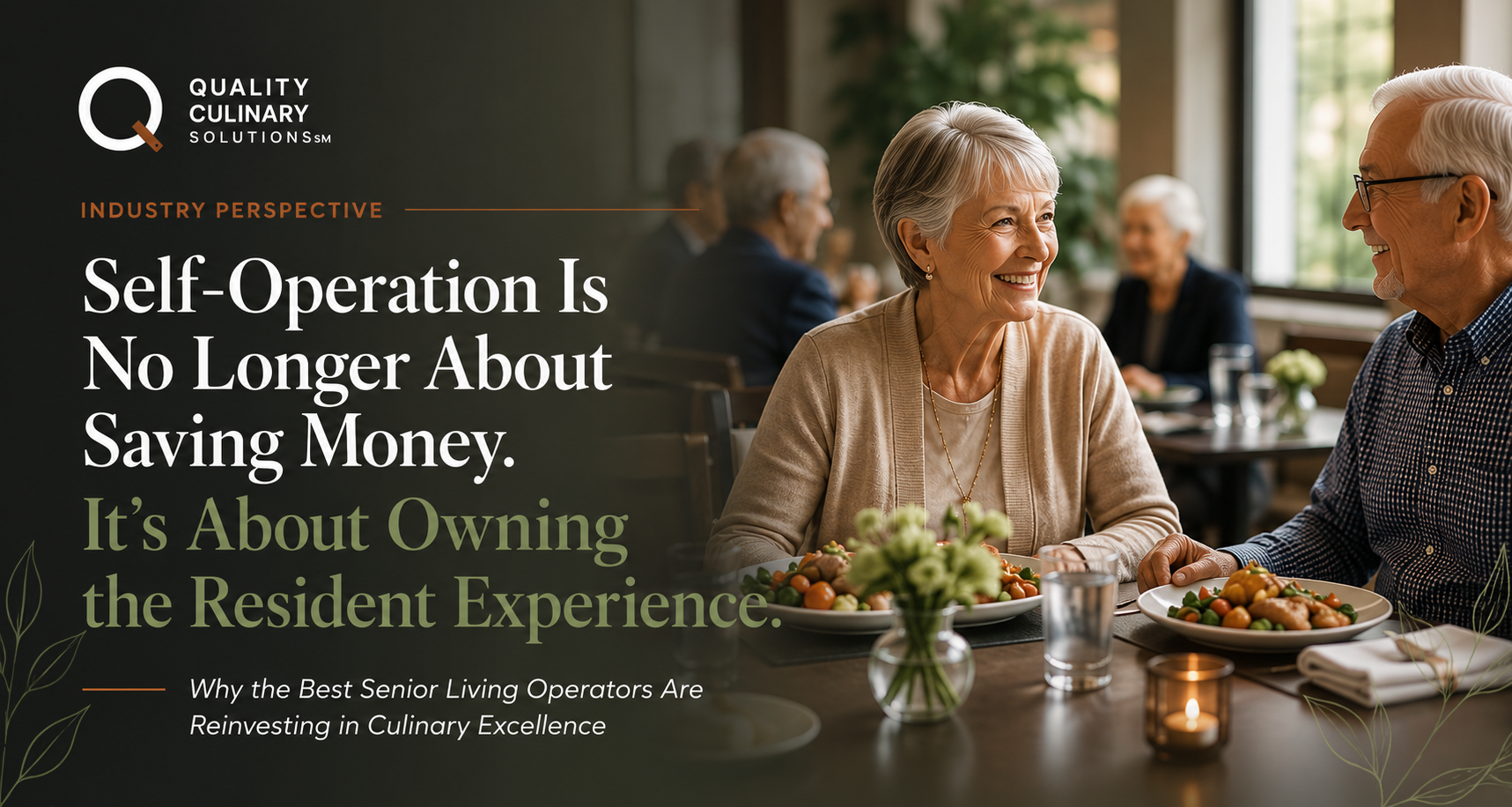
Self-Operation Is No Longer About Saving Money.
Volume 1
Self-Operation Is No Longer About Saving Money.
It’s About Owning the Resident Experience.
Why the Best Senior Living Operators Are Reinvesting in Culinary Excellence
Executive Summary
For years, many senior living organizations viewed self-operated dining primarily as a financial decision.
- Lower management fees.
- Greater purchasing flexibility.
- More operational control.
Today, the conversation has fundamentally changed.
Across the country, leading providers are discovering that the greatest advantage of self-operation is not cost—it is the ability to intentionally design a dining experience that reflects their mission, strengthens culture, improves resident satisfaction, and differentiates their community in an increasingly competitive marketplace.
As occupancy rises and Baby Boomers become the dominant customer, dining has evolved from an operational department into one of the organization’s strongest strategic assets.
The communities that recognize this shift will outperform those that continue treating dining as a support function.
The Industry Has Changed
Senior living is entering its most competitive era in decades.
- Occupancy has returned to pre-pandemic highs.
- New residents bring significantly higher expectations.
- Families compare communities online before touring.
- Dining consistently ranks among the top drivers of resident satisfaction.
The result?
Communities are no longer competing on apartments.
They’re competing on lifestyle.
And nowhere is lifestyle more visible than the dining room.
The Old Self-Operation Model
Historically, self-operation focused on three objectives.
- Reduce food cost.
- Control labor.
- Purchase directly.
Success was measured almost entirely through financial statements.
Today those metrics remain important—but they are no longer enough.
Operators now realize they must also measure:
- Resident satisfaction
- Hospitality culture
- Employee engagement
- Clinical nutrition
- Operational consistency
- Brand experience
Dining has become an enterprise function—not simply a culinary one.
The Five Characteristics of High-Performing Self-Operated Communities
- Culinary is a Leadership Function
Successful organizations place dining leadership at the executive table.
The dining program influences marketing, wellness, occupancy, clinical outcomes, and resident engagement—not just food production.
- Hospitality Is Systemized
Exceptional service isn’t dependent upon one great dining manager.
- It is taught.
- Measured.
- Coached.
- Repeated.
Hospitality becomes part of the organization’s operating system.
- Menus Become Strategic
Leading organizations design menus around:
- Resident preference
- Seasonality
- Cross-utilization
- Labor efficiency
- Nutrition
- Food cost
- Operational simplicity
A menu is no longer just a recipe book.
It is an operating model.
- Data Drives Decisions
The best operators don’t rely solely on anecdotal feedback.
They monitor:
- Resident satisfaction
- Participation
- Plate waste
- Food cost
- Labor productivity
- Menu popularity
- Procurement trends
Continuous improvement begins with visibility.
- Continuous Improvement Replaces Annual Projects
Dining excellence isn’t achieved through one menu rollout.
It is built through hundreds of small improvements.
- Training.
- Coaching.
- Observation.
- Measurement.
- Recognition.
- Every week.
What We See Most Often
After working alongside self-operated communities across the country, several themes consistently emerge.
Communities often have passionate culinary teams.
Dedicated leaders.
Committed caregivers.
Yet they frequently lack the systems needed to sustain excellence.
The opportunity usually isn’t better people.
It’s better structure.
Where QCS Fits
Quality Culinary Solutions partners with self-operated senior living organizations to help them transform dining from an operational necessity into a competitive advantage.
Our work focuses on five interconnected capabilities:
- Culinary Excellence
- Experience Design
- Operational Excellence
- Procurement & Supply Chain
- Training & Education
Together these capabilities help organizations improve resident experience while building systems that are sustainable, measurable, and scalable.
Looking Ahead
The future of senior living dining will not belong to organizations with the largest food budgets.
It will belong to those that intentionally connect culinary excellence, hospitality, operational discipline, and continuous improvement.
Because residents don’t remember food cost.
They remember how dining made them feel.
About Quality Culinary Solutions
Quality Culinary Solutions partners with self-operated senior living organizations to elevate culinary performance, strengthen hospitality culture, optimize operations, and create dining experiences that residents choose to talk about.